Choosing induction cookware is not just a matter of finding a magnetic symbol on a box. A pan also needs a base that sits flat, heats evenly, and suits the meals you actually cook. A lightweight skillet may respond quickly, while a heavy Dutch oven holds heat for slow simmering. Small details matter, too: handle comfort, lid fit, and how easily a pan cleans after a sticky sauce.
Cookware-testing editor Lisa McManus of America’s Test Kitchen offers a useful perspective: judge cookware by how it performs, not by its label. That practical idea guides this roundup. We compare ten Induction Ready Cookware sets for induction compatibility, construction, everyday handling, and overall value. Where useful, we consider how stainless steel, nonstick coatings, and heavier materials behave on a magnetic cooking surface. No set is perfect.
The right choice depends on your kitchen. A compact set may suit a small apartment, while frequent family cooking may call for more pieces and sturdier handles. Check the manufacturer’s care instructions, too; dishwasher-safe claims do not always mean a pan will look new after repeated cycles. We also recognize a limitation: cookware can behave differently across induction cooktops, especially when burner sizes and power settings vary. Use this guide to narrow the field, then match the set to your stove, cooking habits, and budget.
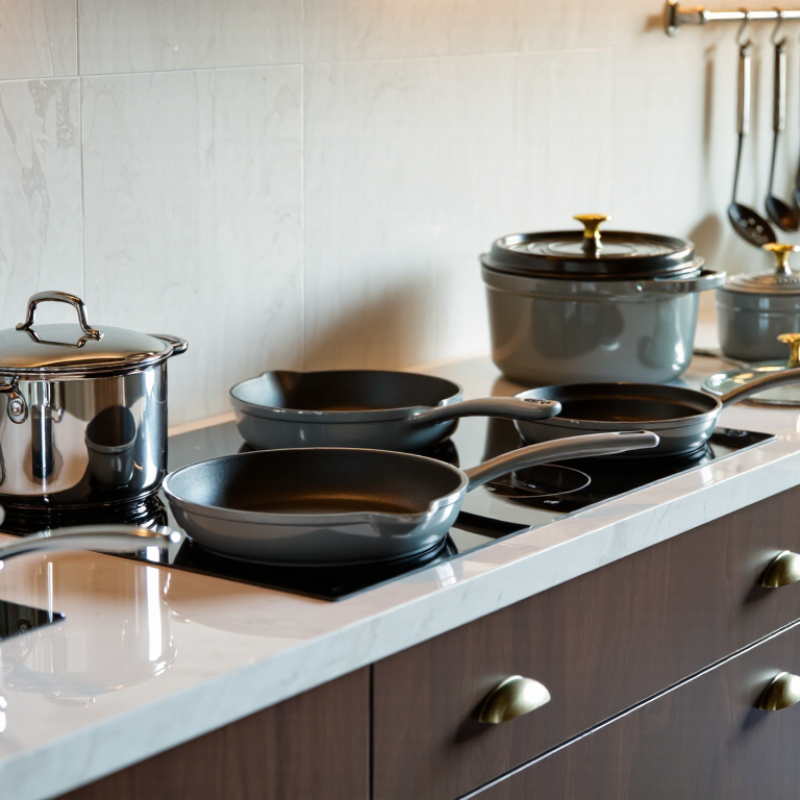
Induction-ready cookware works through magnetism, not a flame or a glowing burner. A coil beneath the glass surface creates a changing magnetic field. When a compatible pan sits above it, the pan itself heats up. The cooktop stays comparatively cool, though heat from the pan can warm the glass. That difference makes induction responsive: turning down the setting can quickly reduce the energy reaching the cookware.
The base must contain magnetic material, usually iron or magnetic stainless steel. Some aluminum and copper pans also work, but only when they include a compatible magnetic layer. A flat base helps the pan make steady contact with the cooktop. Not every pan labeled stainless steel is induction-ready, so check the maker’s instructions. It is tempting to judge by appearance. That can be misleading.
Tips: Hold a small magnet against the pan’s base. If it sticks firmly, the pan is generally suitable; a weak pull may mean uneven performance. Keep the base clean and smooth to reduce scratching, and lift cookware instead of sliding it. Check your cooktop manual, too. Small details matter. I would still test unfamiliar pans before relying on them for dinner.
Induction cooktops heat cookware through a magnetic field, so the pan needs a magnetic base. In this chart, 1 means compatible and 0 means not compatible. Some stainless-steel cookware is not magnetic, while aluminum and copper cookware can work if it has a magnetic base.
Top 10 Best Induction Ready Cookware Sets in 2026
Key Criteria for Evaluating Cookware Sets
Begin with magnetic response and base geometry. A refrigerator magnet should hold firmly beneath each pan, not just one piece. Check that the base sits flat on the hob without rocking. Match pan diameter to burner size, especially for small saucepans. Poor contact can cause uneven heating and wasted time. The U.S. Department of Energy’s induction-cooking guidance says induction transfers about 85% of energy to food, compared with roughly 32% for gas cooking. Compatible cookware is essential to that advantage.
Material and construction matter, too. A layered base can spread heat while keeping a magnetic exterior. Look for a smooth, thick base, secure handles, and lids that fit without rattling. Check the oven-safe temperature and care instructions. Narrow corners and exposed rivets can trap food. Small details. Yet they affect cleanup.
Set size can be misleading. Count the pans you will actually use, not just the pieces listed on the box. A heavy pan may feel sturdy, but awkward handle balance is hard to judge from specifications alone. I would compare weights and inspect handle clearance before buying. There is no perfect set; priorities differ between quick weeknight meals and slow simmering.
A brand-neutral guide to common cookware constructions, ordered by general-purpose versatility. Compatibility and oven limits vary by product; check the cookware maker’s specifications before buying.
| Rank | Cookware Set Type | Induction-Ready Check | Key Strengths | Trade-Offs and Care | Best Suited To | What to Verify |
|---|---|---|---|---|---|---|
| 1 | Fully clad 3-ply stainless steel | The exterior layer must be magnetic stainless steel. | Aluminum between stainless layers helps spread heat; durable and useful for a wide range of cooking tasks. | Food can stick without proper preheating and enough cooking fat. Stainless steel may discolor or develop heat tint. | Everyday cooking and shoppers seeking a versatile, long-lasting set. | Confirm the magnetic exterior, fully clad construction, handle comfort, and oven-safe limits. |
| 2 | Fully clad 5-ply stainless steel | Look for a magnetic stainless-steel exterior; ply count alone does not establish compatibility. | Multiple metal layers can provide a sturdy feel and distribute heat through the sides as well as the base. | Often heavier than simpler constructions; extra layers do not guarantee better cooking results. | Cooks who prefer substantial cookware and frequently use saucepans or sauté pans. | Check actual weight, layer construction, pan balance, and the manufacturer’s induction guidance. |
| 3 | Disk-bottom stainless steel | The base needs a magnetic layer, usually as part of a bonded disk. | A layered base can combine a magnetic exterior with a heat-spreading metal core; often a practical value option. | Heat distribution may differ between the base and sidewalls; inspect the base for secure, even bonding. | Budget-conscious buyers who mainly cook in the center of the pan. | Check base diameter, flatness, induction compatibility, and whether the disk is firmly bonded. |
| 4 | Stainless steel with a copper core | Requires a magnetic stainless-steel exterior or a magnetic induction plate. | Copper conducts heat efficiently; a layered design can pair that core with a stainless cooking surface. | Copper-core construction does not make a pan induction-compatible by itself; layered cookware can be costly or heavy. | Experienced cooks who value responsive heat adjustment in a multi-layer pan. | Confirm the magnetic outer layer and whether the copper core extends through the base, sides, or both. |
| 5 | Enameled cast iron | The cast-iron body is magnetic and generally works on induction cooktops. | Retains heat well; the enamel coating provides a non-reactive cooking surface and does not require seasoning. | Heavy and slower to heat or cool; enamel can chip if knocked or subjected to rough handling. | Slow cooking, braising, soups, and dishes that benefit from heat retention. | Check weight, lid fit, cooktop guidance, and any temperature limits for the pot and lid. |
| 6 | Bare cast iron | Cast iron is magnetic and works with induction; use care when moving it across a glass cooktop. | Strong heat retention and a durable cooking surface when maintained; can be used on many heat sources. | Heavy; needs drying and seasoning to help protect the surface from rust. Avoid sliding it over glass. | Searing, frying, and cooks comfortable with regular pan care. | Check pan weight, base flatness, and care instructions; a warped base may not contact the cooktop evenly. |
| 7 | Carbon steel | Carbon steel is magnetic and generally induction-compatible. | Can heat quickly and handle high-heat cooking; a seasoned surface can become more release-friendly with use. | Requires seasoning and prompt drying; acidic foods can affect seasoning, especially on a new pan. | Stir-frying, searing, and cooks willing to maintain seasoned cookware. | Check base flatness, pan thickness, handle design, and seasoning instructions. |
| 8 | Hard-anodized aluminum with an induction plate | Aluminum alone is not induction-compatible; the cookware needs a magnetic base layer or bonded plate. | Hard-anodized aluminum is valued for a durable surface; the added magnetic base enables induction use. | The induction plate can affect weight and heat response; confirm whether the interior is coated and follow its care directions. | Cooks who prefer aluminum-based cookware and want it to work on induction. | Look for explicit induction compatibility, a flat base, and clear instructions for utensils and cleaning. |
| 9 | PTFE nonstick with a magnetic base | The cookware needs a magnetic stainless-steel layer or induction plate beneath its nonstick body. | The nonstick surface can make delicate foods easier to release and simplify cleanup when used as directed. | Coatings can wear over time; avoid overheating an empty pan and follow the maker’s utensil and cleaning guidance. | Eggs, pancakes, and low-to-medium-heat everyday cooking. | Check induction compatibility, coating-care instructions, replacement availability, and oven limits. |
| 10 | Ceramic-coated nonstick with a magnetic base | The base must contain a magnetic layer; the ceramic coating itself does not provide induction compatibility. | Provides a nonstick-style cooking surface over an induction-compatible base. | Release performance can decline with wear; use gentle utensils and follow the manufacturer’s heat and cleaning instructions. | Cooks seeking a coated surface for routine low-to-medium-heat tasks. | Verify induction compatibility, care requirements, coating warranty, and oven-safe limits. |
Top 10 Induction-Ready Cookware Sets in 2026 should be compared by compatibility, construction, and everyday usefulness—not piece count alone.
The U.S. Department of Energy’s Energy Saver guidance estimates that induction transfers about 85% of its energy to cookware, versus roughly 32% for gas and 75% for conventional electric resistance cooking. Those figures describe energy transfer, not guaranteed savings on every household bill. Still, they make a sound, even-heating base worth seeking.
Look for magnetic stainless steel or a clearly specified induction-compatible base. A small magnet helps. It should cling firmly to the bottom.
For each set, check whether the pans sit flat and match the cooktop’s usable heating zones. A warped base can wobble on the glass and heat unevenly. Count the useful pieces: a small saucepan, a lidded pot, and a skillet may earn more cupboard space than several rarely used pans.
Check handle comfort, lid fit, oven limits, and whether the cookware is dishwasher-safe. A magnet test can mislead. It confirms magnetic material, not even heating or durable construction. That distinction is easy to overlook, and rankings should say how compatibility was checked.
DOE efficiency estimates are useful context, but they cannot tell you whether a particular set feels balanced when full. The best shortlist makes those trade-offs visible rather than treating ten pieces as automatically better.
Induction-ready cookware depends on more than a magnetic label. The base must make steady contact with the cooktop, and a flat, substantial base usually heats more evenly. Stainless steel with an encapsulated or layered magnetic core can offer responsive cooking and good durability. Cast iron holds heat well, though its weight and slower temperature changes may feel less convenient for quick meals. A small magnet is a useful first check. Still, it cannot reveal how evenly a pan heats.
Coatings and construction shape everyday performance. Nonstick surfaces release eggs easily, but high heat and metal utensils can shorten their useful life. Bare stainless steel handles browning well, although food may stick when the pan is too cool or dry. Clad cookware often balances responsiveness with heat distribution, but thicker sets can cost more and feel heavy. Check that lids fit securely and handles stay comfortable when lifted with a full pan. Small details matter. On a smooth induction surface, rough or warped bottoms can also affect contact, and that is easy to overlook when shopping. Set size deserves a second look: a large collection may include pieces that rarely leave the cupboard. I would compare the pans you actually use, not just the number in the box.
Induction-ready cookware must couple reliably with the cooktop, not just carry a compatible label. Check the underside for a magnetic layer; a refrigerator magnet should hold firmly against the base. A weak or patchy pull can mean uneven heating. Fit matters, too. Choose pans whose flat bottoms match the cooking zone, and center them before switching on. A small mismatch can reduce contact and slow heating. A quick check helps.
The U.S. Department of Energy’s Energy Saver guidance estimates that induction transfers about 85% of its energy to cookware, compared with roughly 32% for gas cooking. These figures describe general cooking efficiency, not a promise that every pan heats perfectly; results vary with cookware and use. Keep bases clean and dry, and lift pans instead of dragging them across the glass. That simple habit can help prevent scratches. Avoid sudden temperature changes, such as placing a hot pan under cold water, which may warp its base. Compatibility can also change with wear. Check for a wobbling bottom now and then. It is easy to miss.
Place a small refrigerator magnet under the pan. It should hold firmly. Test every piece, not just one.
No. It confirms magnetic material, but not flatness or even heating. Check the base on a level surface, too.
A flat base sits steadily on the glass and supports better contact. A warped pan may wobble and heat unevenly.
Yes. Match each pan to the cooktop’s usable heating zone. This matters especially for small saucepans.
Look for a smooth, thick base, secure handles, and lids that fit without rattling. Small details matter.
Count the pans you will actually use. A saucepan, lidded pot, and skillet may be enough. More pieces are not always better.
Compare handle balance and clearance, and see whether lids sit securely. Specifications cannot fully show how a full pan feels. I might still misjudge it.
A U.S. energy guide estimates about 85% energy transfer for induction, compared with roughly 32% for gas. These figures do not guarantee lower household bills.
This guide explains how Induction Ready Cookware works and what makes a set suitable for induction cooking. It outlines the key factors to consider when comparing options, including magnetic compatibility, material, construction, heat distribution, durability, comfort, and ease of care. A practical overview of ten cookware sets for 2026 helps readers compare different designs and features according to their cooking needs, kitchen setup, and budget.
The guide also compares common materials and their effects on performance, from responsiveness to heat retention and everyday maintenance. It offers tips for checking compatibility with induction cooktops and caring for cookware to help preserve its condition over time. Together, these sections provide a clear starting point for choosing a versatile set that works reliably on an induction surface and suits a range of everyday cooking tasks.

Top Ideas