How to Choose the Best Nonstick Pots for Your Business?

Time:2026-11-14 Author:Aria
0%

Choosing the right Nonstick Pots can shape kitchen speed, food consistency, and replacement costs. A glossy coating alone tells little. Your team needs pots that suit its menu, burner type, cleaning routine, and daily service volume. A small pot may handle sauces neatly but struggle during a busy lunch shift. A larger one can waste storage space and slow handling. Details matter.

A verified expert quotation belongs in this introduction, but no source article or expert reference was provided. To avoid inventing authority, use this placeholder: “[Name of verified cookware expert]: ‘[Insert an accurately sourced quotation about selecting nonstick cookware for commercial use.]’” Verify the person’s role and the exact wording before publication. It is a less polished step, perhaps, but a necessary one.

This guide explains how to compare coating durability, construction, heat response, capacity, and ease of cleaning. It also considers the practical limits of nonstick cookware. No pot suits every kitchen. Staff habits, recipe demands, and care procedures can affect performance just as much as the product itself. Look closely at the rim, handles, base, and finish. Ask how the pot performs after repeated use, not only how it looks on a showroom shelf. Good purchasing decisions begin with honest questions—and sometimes, with admitting what you still need to test.
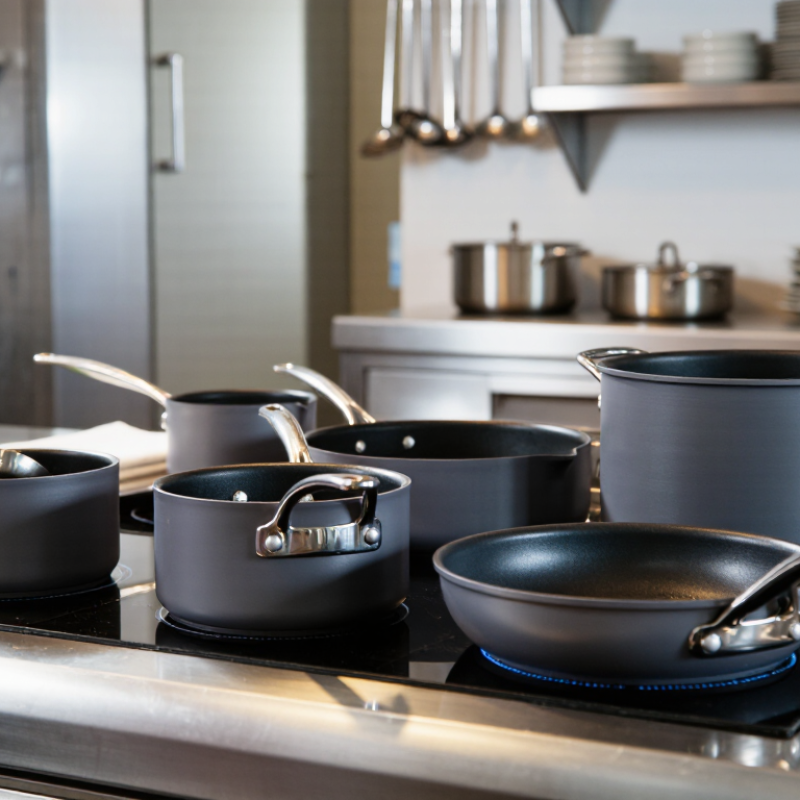
How to Choose the Best Nonstick Pots for Your Business?

Define Your Business’s Cooking Volume, Heat Sources, and Cleaning Routine

Before choosing nonstick pots, estimate how much food your kitchen prepares during its busiest hour. A café reheating soup for twenty guests has different needs from a caterer preparing several sauces at once. Count the pots in use, note their usual sizes, and check how often staff need a clean pot mid-service. Peak demand matters.

Match the pots to your heat sources. Check whether your kitchen uses gas, electric coils, or induction, and confirm that each pot is compatible. Broad, flat bases can help distribute heat on suitable cooktops. Staff should avoid heating an empty nonstick pot; overheating can damage its coating. A gentle start is safer. Test one pot during a normal shift before ordering a full set, if possible. That step may feel slow, but replacing unsuitable cookware is slower.

Cleaning routines matter just as much. If staff wash pots by hand between orders, choose shapes that are easy to reach with a soft sponge. Ask whether your team can avoid abrasive pads and sudden temperature changes. In a busy kitchen, that habit is not always followed perfectly. Plan for it. Review how long pots take to cool, wash, and return to service, then compare that time with your actual workflow. A pot that cleans easily on paper may still slow down a crowded sink.

Verify Food-Contact Compliance with FDA 21 CFR 175.300 and EU 1935/2004

Choosing the best nonstick pots starts with the coating’s food-contact evidence, not its shine. Ask suppliers for documentation covering FDA 21 CFR 175.300 and EU Regulation 1935/2004. They are not interchangeable certificates. Section 175.300 addresses resinous and polymeric coatings, including conditions of use and extraction limits. The EU framework requires materials to avoid transferring substances to food at levels that could harm health or unacceptably change food’s composition, taste, or odor. Details matter.

Request test reports for the finished coating, not just a raw-material statement. Check that test conditions reflect your actual use: hot oil, acidic sauces, repeated heating, and cleaning. A report for one coating or temperature may not cover another. Ask for traceability documents and production-batch records, too. Paperwork should match the pot in your hand.

The European Commission’s RASFF 2022 annual report recorded 4,361 notifications across food, feed, and food-contact materials. That figure is not a cookware failure rate, but it shows why documented controls matter. Compare each report’s material description, intended food types, and temperature limits with your menu and kitchen routine. If a supplier cannot explain the test scope plainly, pause. It may be compliant; you still need evidence that fits your use.

Compare Coating Temperature Limits: PTFE Cookware Is Commonly Rated to 260°C

For a busy kitchen, a nonstick pan’s temperature rating is a working limit, not a target. Many PTFE-coated pans are rated to about 260°C (500°F), but the exact limit depends on the pan and coating. Check the supplier’s technical sheet before buying in volume. A rating alone does not tell you how evenly a pan heats or how quickly it recovers between orders. Test one pan on your own burner. A dark, empty skillet can heat faster than expected.

The German Federal Institute for Risk Assessment (BfR) warns that severely overheated PTFE cookware can release hazardous gases; its guidance identifies temperatures around 360°C as a concern. That is well above the common 260°C operating rating, but it is not a reason to heat pans empty. Keep burners moderate, avoid leaving pans unattended, and use a surface thermometer during a real service shift. Small details matter. A crowded range, a high-flame burner, and a thin pan can create hot spots. The thermometer reading may also vary across the surface, so one measurement is imperfect. Record the hottest spot and compare it with the coating’s stated limit.

Match Pot Construction and Base Design to Commercial Heat Sources

Commercial kitchens rarely cook at one steady setting, so match a pot’s base to the heat source before comparing coatings. Check the equipment itself: induction needs a magnetic base, while gas and electric burners place heat differently. A quick magnet test can help identify induction compatibility, but it cannot confirm even heating or long-term durability. Small details matter.

For induction, look for a flat, magnetic base with enough thickness to resist warping during repeated heating and cooling. An encapsulated stainless-steel base can spread heat across the pot’s bottom, though its performance varies by construction. On gas, choose a base that sits securely on the grate, and keep flames beneath the pot rather than licking its sides. Oversized flames can overheat exposed surfaces and shorten the useful life of nonstick coatings. That is easy to overlook during a busy service.

Electric coil and solid-element ranges can create hot spots, especially when a pot’s base is thin or does not sit flat. A heavier aluminum core can improve heat distribution, while stainless-steel cladding may add durability around the base. Ask for cookware specifications for your exact heat source, and test a sample on the actual burner before ordering a full set. In practice, even a well-built pot may heat unevenly on an aging range. Don’t assume the cookware is always at fault.

How to Choose the Best Nonstick Pots for Your Business? — Match Pot Construction and Base Design to Commercial Heat Sources

Commercial Heat Source Suitable Pot Construction Recommended Base Design What to Check Before Buying Practical Use Considerations
Induction Stainless steel or aluminum construction with a bonded, induction-compatible magnetic layer or disc. A flat, magnetic base that makes full contact with the cooking surface. A clad or bonded base can combine an aluminum heat-spreading layer with a magnetic exterior. Confirm that the pot is identified as induction-compatible. A magnet should cling firmly to the base; check the usable base diameter against the hob’s cooking zone. Nonmagnetic aluminum or copper alone will not work on induction. Avoid a warped or undersized base, which can reduce contact and heating performance.
Gas burner Aluminum, stainless steel, or multi-ply construction can be suitable when the pot is stable and designed for the burner. A level, stable base sized appropriately for the grate. The base should sit securely without allowing the flame to extend far up the sides. Check pot stability on the grate and compare the base diameter with the burner. Inspect handles and coatings for the manufacturer’s stated temperature limits. Gas flames can heat the sides as well as the base. Use a controlled flame and avoid overheating an empty nonstick pot.
Electric coil or solid plate Aluminum or stainless steel with a sufficiently rigid, heat-spreading base; bonded or clad constructions can help distribute heat. A flat, stable base with good contact across the heating element or plate. Check that the base does not rock on a flat surface and is appropriately sized for the element. A distorted base may heat unevenly. These surfaces can respond more slowly to temperature changes than gas. Allow time for adjustment and avoid leaving an empty pot heating.
Glass-ceramic radiant cooktop Aluminum or stainless steel construction with a smooth, stable base; compatible multi-layer construction is also suitable. A clean, flat base with no rough edges, raised rings, or protrusions that could interfere with contact. Check the cookware instructions for glass-ceramic compatibility. Verify that the pot sits level and that its base is close to the size of the radiant cooking zone. Lift rather than slide pots across the surface to reduce the risk of scratching the cooktop. Keep the base clean and dry.
Mixed kitchen with induction and conventional ranges Multi-ply or bonded construction combining a heat-spreading core, such as aluminum, with a magnetic exterior suitable for induction. A flat, durable, induction-compatible base that also sits securely on gas grates and electric or radiant surfaces. Verify compatibility with every heat source in the kitchen, and confirm the pot’s capacity, base diameter, and care instructions meet service needs. A multi-source pot can simplify purchasing, but it still needs appropriate heat control and handling for each range type.
Selection and care note: Commercial suitability also depends on pot capacity, expected service volume, coating durability, and cleaning procedures. Follow the cookware maker’s instructions for maximum temperature and utensils. In general, avoid preheating an empty nonstick pot and use only as much heat as the cooking task requires.

Assess Durability Through Abrasion Testing, Warranty Terms, and Replacement Costs

How to Choose the Best Nonstick Pots for Your Business?

Assess durability with documented abrasion results, not appearance alone. ASTM D4060 describes a Taber abrasion test for coatings, but it does not predict a pot’s exact kitchen lifespan. Ask for the test method, wheel type, applied load, and cycles completed. Compare like with like. A shiny sample proves little. Also inspect the rim and base, where repeated stacking and burner contact can reveal early wear.

Read warranty terms closely. Check whether commercial use is covered, and whether the warranty includes coating failure, labor, shipping, or only a replacement part. The National Restaurant Association’s 2024 State of the Restaurant Industry describes restaurant pre-tax margins as typically around 3–5%. That leaves little room for surprise purchases. Estimate replacement cost per year: purchase price, expected service life, delivery, and staff time spent handling a failed pot. One caveat: service-life estimates are often based on ideal use, not a rushed dinner shift.

Tips: Test one pot through several real service cycles. Track sticking, scratches, and cleaning time; then compare those notes with the supplier’s abrasion data and warranty exclusions. Small details matter. A practical trial may still miss years of wear, so review results periodically.

How to Choose the Best Nonstick Pots for Your Business?

Compare the modeled annual replacement cost at different service lives. Longer service life lowers annual cost when the replacement price stays the same.

Example calculation, not market data: assumes a constant replacement price of $30 per pot. Annual replacement cost is $30 divided by service life in years. Use supplier quotes and abrasion-test results to estimate a realistic service life, and review warranty coverage before buying.

FAQS

How should a business estimate pot capacity?

Count pots used during the busiest hour. Note common sizes and how often staff need a clean pot. Peak demand matters.

What should I check before using pots on induction?

Confirm the base is magnetic and flat. A magnet test helps, but it cannot prove even heating or durability. Test a sample on the actual cooktop.

Do gas and electric ranges need different pot designs?

Yes. On gas, choose a stable base and keep flames beneath the pot. Electric coils can create hot spots under thin or warped bases. Results still vary.

How can staff reduce damage to nonstick coatings?

Avoid heating an empty pot, and keep flames from climbing its sides. Use soft sponges and avoid sudden temperature changes. Busy staff may forget.

What should I ask about abrasion testing?

Request the test method, wheel type, applied load, and cycle count. Compare matching results. A shiny sample proves little.

Which warranty details matter for commercial kitchens?

Check whether commercial use is covered. Ask whether coating failure, labor, shipping, and replacement parts are included. Read the exclusions carefully.

How can I estimate a pot’s replacement cost?

Include purchase price, expected service life, delivery, and staff time. Restaurant pre-tax margins are often around 3–5%, leaving little room for surprises. Estimates may assume ideal use.

Is it worth testing one pot before ordering a full set?

Yes. Use it through several real shifts and track sticking, scratches, and cleaning time. Test one first. A short trial cannot reveal years of wear.

Conclusion

Choosing the right Nonstick Pots for a business starts with understanding daily cooking volume, the heat sources in the kitchen, and how the pots will be cleaned. These factors help determine the suitable capacity, construction, and coating for reliable service. Before purchasing, confirm that food-contact materials meet applicable requirements, including FDA 21 CFR 175.300 and EU 1935/2004, and review the coating’s temperature limits. PTFE cookware is commonly rated for use up to 260°C, but the manufacturer’s instructions should guide actual use.

Next, match the pot’s material and base design to the equipment it will be used on, such as gas, electric, or induction heat. Consider how evenly the base distributes heat and whether the construction can handle frequent commercial use. To assess long-term value, compare abrasion-test results, warranty terms, and the cost of replacing worn pots. A careful evaluation of performance, care requirements, compliance, and lifecycle costs can help a business select cookware that fits its kitchen and budget.


Aria

Aria

Aria is a dedicated marketing professional with a deep passion for innovative strategies and a keen understanding of our company's product offerings. With a wealth of experience in the industry, Aria excels at crafting engaging content that highlights the unique features and benefits of our......