How to Choose Stainless Steel Bakeware for Your Business?

Time:2026-10-24 Author:Amelia
0%

Choosing Stainless Steel Bakeware for a business is not simply a matter of selecting the brightest trays. It affects production speed, food consistency, cleaning routines, and replacement costs. A small bakery may need lightweight sheet pans for frequent handling. A hotel kitchen may require heavier pans that resist warping under daily oven heat. The right choice depends on volume, recipes, oven type, and staff habits.

Chef Thomas Keller once said, “A recipe has no soul. You, as the cook, must bring soul to the recipe.” His words also apply to commercial equipment. Stainless Steel Bakeware cannot rescue poor temperature control or careless maintenance. However, well-designed pans can support repeatable results. Even browning matters. So does a smooth rim.

This guide examines stainless steel grades, thickness, surface finishes, heat distribution, edge strength, and cleaning requirements. It also considers practical details, such as whether a pan fits standard racks or stacks without sliding. Those details are easy to overlook. They often become expensive later.

There is no perfect pan for every business. A polished tray may look professional but show fingerprints quickly. A thicker model may last longer, yet feel tiring during a busy shift. Some recommendations may need reconsideration after real kitchen testing. That is normal. Before purchasing in bulk, test sample pans with your actual dough, oven settings, detergents, and production schedule. Evidence from your kitchen should guide the final decision.
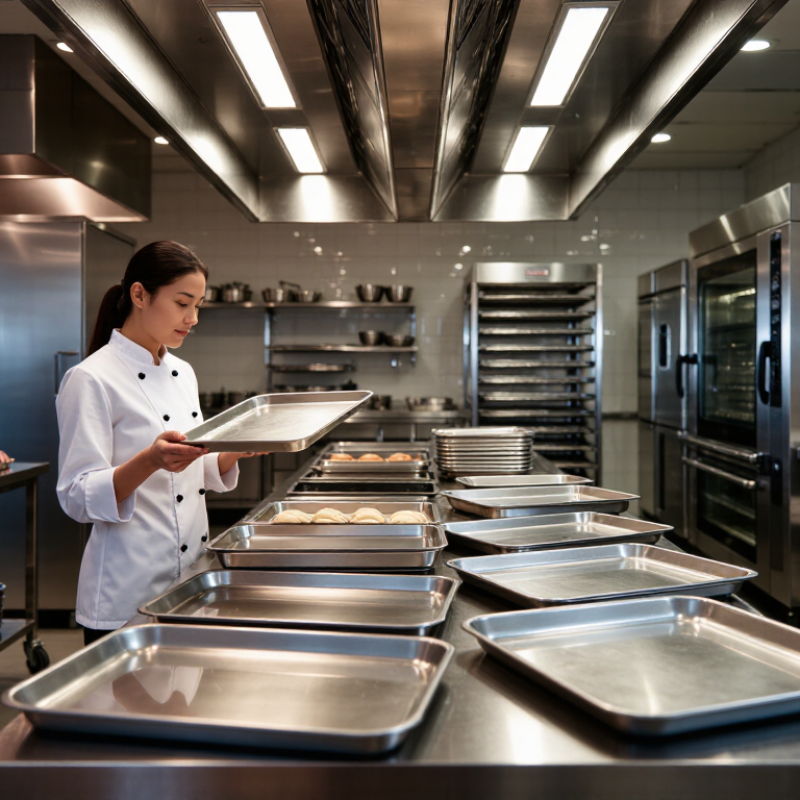
How to Choose Stainless Steel Bakeware for Your Business?

Define Your Business Requirements for Stainless Steel Bakeware

Choosing stainless steel bakeware starts with your production reality, not a catalog photograph. Define what you bake, how often, and in what quantities. A pastry kitchen may need shallow trays for even browning. A bread operation may require deeper pans with stronger edges. Measure oven cavities, rack spacing, storage shelves, and washing areas before ordering. Small gaps matter.

Record temperatures, batch weights, and expected daily cycles for each pan. Commercial use can expose weak corners, warped bases, or handles that become awkward with gloves. Choose a suitable steel grade and finish for repeated heating, cooling, cleaning, and food contact. Ask suppliers for material documentation, thickness information, dimensional tolerances, and care guidance. These details support traceability and more reliable purchasing decisions. Do not rely on appearance alone.

I once assumed a heavier tray would always perform better. That assumption was incomplete; it increased lifting strain and slowed production. Test one sample during a normal shift before committing to a large order. Check heat distribution by comparing color and doneness across the tray. Inspect corners after washing, and note whether food sticks during release. Your staff’s feedback is practical evidence. Leave room for revision.

Compare Steel Grades, Thicknesses, and Construction Methods

How to Choose Stainless Steel Bakeware for Your Business?

Steel grade affects durability, corrosion resistance, and cleaning performance. Grade 304 suits most bakeries because it handles moisture, heat, and routine washing well. Grade 316 offers stronger resistance to salt and acidic ingredients, but its higher cost may not suit every operation. Grade 430 is more budget-friendly and magnetic, yet it generally needs better moisture control to avoid surface corrosion. Check the material certificate when possible. Labels alone can be unclear.

Thickness influences heat response and service life. Thin sheets heat quickly and reduce equipment weight, but they may bend under repeated use. Thicker steel feels more stable and resists dents, although it can increase purchase and heating costs. For frequent production, compare tray weight, flatness, and edge rigidity. A simple hand-pressure test can reveal weak areas. I once overvalued thickness and ignored poor support around the rim. That was a costly assumption.

Construction methods matter as much as the alloy. Deep-drawn trays have fewer joints, which helps limit trapped residue. Welded corners can work well when the seams are smooth and fully finished. Rolled edges improve handling and reduce sharp contact points. Inspect corners closely. Rough welds collect crumbs and complicate sanitation. Also check whether the base stays flat after heating and cooling cycles. Ask for sample testing with your actual oven temperature, dough weight, and cleaning routine. Laboratory data helps, but daily production often exposes details that specifications miss.

How to Choose Stainless Steel Bakeware for Your Business?

Compare Steel Grades, Thicknesses, and Construction Methods

The chart compares the minimum tensile strength requirements for common stainless steel sheet grades under ASTM A240. Higher tensile strength can support better resistance to deformation, but bakeware performance also depends on thickness, geometry, forming quality, and heat exposure.

Grade Typical composition Best suited for Common thickness range Preferred construction
304 Approx. 18% chromium and 8–10.5% nickel General-purpose commercial bakeware 0.8–1.5 mm Deep-drawn or folded with rolled edges
316 Approx. 16–18% chromium, 10–14% nickel, 2–3% molybdenum Salty, acidic, or high-corrosion food environments 0.8–1.5 mm Deep-drawn with reinforced corners and edges
430 Approx. 16–18% chromium with very low nickel Cost-sensitive, dry-heat applications 0.8–1.2 mm Pressed or folded designs with structural ribs

Reference basis: ASTM A240 minimum tensile-strength requirements for annealed stainless steel sheet and commonly published nominal alloy-composition ranges. Thickness recommendations are practical commercial starting points rather than universal standards.

Select Pan Shapes and Sizes for Your Production Needs

Choosing stainless steel bakeware starts with your production map, not a catalog. In a commercial kitchen, pan shape affects batter flow, heat exposure, cooling time, and packing speed. Measure the product after baking, including expansion and trimming allowance. Round pans suit cakes and tarts, while rectangular pans support bars, sheet cakes, and efficient cutting. Deep pans hold wet batters, but they may slow center baking. Shallow pans release heat faster. Measure twice.

Match pan dimensions to your oven racks and loading pattern. A pan that fits on paper may block airflow beside another pan. Leave practical clearance around the edges, especially in convection ovens. Standardizing two or three sizes can simplify recipes, storage, and staff training.

Yet one size rarely serves every product well. Test a sample batch using your actual batter weight and baking temperature. Record corner color, center moisture, release time, and final dimensions. Weigh the baked pieces. Keep records.

Stainless steel thickness also affects handling and heating response. Heavier pans resist warping, but they increase lifting strain during busy shifts. Lighter pans are easier to move, though they may need stronger support. Choose flat rims, secure corners, and surfaces that clean without harsh abrasion. Avoid selecting pans only by nominal size; internal dimensions matter more. I have seen a pan pass a fit check yet produce uneven portions because its sloped sides reduced the cutting area. That mistake was avoidable, but the test plan was too casual. Review production data after several runs, since seasonal recipes and different operators can expose problems early.

Evaluate Safety, Durability, Cleaning, and Maintenance

Choosing stainless steel bakeware starts with safety, not shine. In commercial kitchens, inspect rims, welds, corners, and stamped surfaces before approving a tray. Stainless steel forms a chromium-rich passive layer, according to the International Stainless Steel Forum. This layer resists corrosion, but it is not invincible. Choose food-contact-grade material with traceable specifications. Avoid flaking coatings, deep pits, and rough seams that can retain batter. The FDA Food Code 2022 recommends cleaning food-contact surfaces at suitable intervals, including at least every four hours for many temperature-controlled foods. Bakeware conditions may differ, so verify the application carefully.

For durability, compare gauge, warping resistance, and thermal cycling rather than weight alone. A thin tray may cool quickly but buckle after repeated oven-to-rack changes. Check flatness on a level table. It sounds basic. It prevents uneven cakes. World Stainless reported 58.4 million tonnes of crude stainless steel production in 2023, but abundant supply does not guarantee quality. Ask for alloy details, surface finish, and test records. A heavier tray is not automatically the better tray.

Cleaning should be boring and repeatable. Remove baked sugar with warm water and a soft nylon pad. Do not use steel wool; embedded iron can create rust-colored marks. Follow documented limits for detergents, dishwashers, and sanitizers. EHEDG hygienic design guidance emphasizes smooth, accessible surfaces and cleanable joints. Test one tray. Record staining, distortion, drying time, and labor minutes for two weeks. Our first choice may be wrong. A tray that looks perfect on day one can fail during a busy weekend.

How to Choose Stainless Steel Bakeware for Your Business? - Evaluate Safety, Durability, Cleaning, and Maintenance
Bakeware Option Typical Material Composition Food-Safety Profile Durability & Corrosion Resistance Cleaning Requirements Maintenance Needs Overall Business Suitability
304 Stainless Steel, Single-Wall Approximately 18% chromium and 8% nickel; commonly known as 18/8 stainless steel. Nonporous, non-reactive with most foods, and free from applied chemical coatings when uncoated. Suitable for normal commercial baking use. Very good resistance to rust and food acids. The thin wall may dent or warp more easily than heavier-gauge construction. Generally easy to wash with warm water, mild detergent, and a soft or non-abrasive pad. Dishwasher compatibility depends on the product design. Dry after washing to reduce water spotting. Remove baked-on residue by soaking instead of using chlorine bleach or harsh abrasives. Very Good
304 Stainless Steel, Heavy-Gauge Usually 18/8 stainless steel with a thicker wall or reinforced rim. Nonporous and coating-free when supplied as bare stainless steel. The smooth surface does not absorb oils, flavors, or odors. Excellent resistance to repeated commercial handling, bending, and moderate impact. Better dimensional stability than lightweight sheet metal. Suitable for frequent cleaning. Confirm whether welded joints, rolled edges, and handles are rated for commercial dishwashing. Inspect rims and welds regularly. Avoid prolonged contact with concentrated salt, acidic cleaners, and chlorine-based sanitizers. Excellent
304 Stainless Steel, Tri-Ply or Clad Base Stainless-steel cooking surfaces bonded to an aluminum core, often with a stainless-steel exterior. The food-contact surface is stainless steel and contains no exposed aluminum when properly manufactured. Good structural strength and improved resistance to warping. Bonded layers should be checked for separation after repeated thermal cycling. Usually easy to clean, although exposed edges or seams may require additional attention. Follow the manufacturer’s dishwasher instructions. Avoid sudden temperature changes, such as placing a hot pan in cold water. Check the bonded base and edges during routine inspections. Excellent for Even Heating
316 Stainless Steel Chromium-nickel stainless steel containing approximately 2–3% molybdenum, depending on the specification. Nonporous and suitable for food contact when produced to applicable food-contact requirements. No coating is needed for corrosion protection. Excellent resistance to chlorides, salt spray, and acidic or humid environments. Often justified for coastal, marine, or high-salt operations. Cleans similarly to 304 stainless steel. Rinsing and drying remain important because deposits can still stain the surface. Use when environmental exposure is severe. Do not assume 316 is immune to pitting; remove salt and chemical residues promptly. Best for Harsh Environments
430 Stainless Steel Ferritic stainless steel containing approximately 16–18% chromium and little or no nickel. Suitable for food-contact applications when the finished product meets relevant requirements. It is less resistant to aggressive chemicals than 304 or 316. Good oxidation resistance in dry baking environments, but lower resistance to salt, acids, and chlorides than austenitic grades. Easy to clean with mild detergent. Avoid chlorine-containing products and prolonged exposure to salty or acidic food residues. Inspect for tea staining, pitting, and discoloration, especially in humid kitchens or where aggressive sanitizers are used. Good for Dry Baking
Stainless Steel with Nonstick Coating Stainless-steel body with a factory-applied polymer or ceramic nonstick surface. Food safety depends on the coating specification, condition, and temperature limit. Damaged or peeling surfaces should be removed from service. Lower long-term durability than bare stainless steel because scratches, overheating, and metal utensils can damage the coating. Use soft sponges and non-abrasive cleaners. Hand washing generally helps extend coating life, even when dishwasher use is permitted. Follow the stated temperature limit and utensil guidance. Replace if the coating blisters, flakes, or exposes the base metal. Good for Easy Release
Selection note: For most commercial bakeries, heavy-gauge 304 stainless steel offers a balanced combination of food safety, durability, cleanability, and cost. Choose 316 stainless steel when frequent exposure to salt, chlorides, humidity, or aggressive cleaning chemicals is expected. Always verify the product’s gauge, weld quality, oven-temperature limit, dishwasher rating, and applicable food-contact compliance before purchase.

Review Suppliers, Pricing, Customization, and Long-Term Value

Choosing stainless steel bakeware is a purchasing decision, not merely a material preference.

Supplier quality should be checked through factory audits, food-contact documentation, sample testing, and delivery records. Ask for steel grade, thickness, dimensional tolerance, and welding details.

ASTM A240 provides specifications for stainless steel plate and sheet
NSF/ANSI 2 addresses food equipment safety

These references create a more reliable comparison.

Pricing needs a wider lens.

World Stainless reported 58.4 million tonnes of crude stainless steel production in 2023, showing a large but variable supply base. Request itemized quotations for tooling, polishing, packaging, freight, and replacement parts. Compare at least three suppliers.

A cheaper tray can hide thinner walls, uneven corners, or faster warping. That is not a saving. It is delayed cost.

My own purchasing view has changed here: the lowest offer deserves more questions, not immediate approval.

Customization should solve a production problem.

Specify oven dimensions, stacking clearance, rim shape, surface finish, and cleaning requirements. Small design changes can improve release, handling, and storage. Yet customization may increase minimum order quantities and slow replenishment.

Confirm pilot samples before approving volume production.

For long-term value, calculate cost per bake cycle, not only cost per unit. Consider labor, rejected batches, energy use, repair frequency, and service life.

A 2024 report from the International Energy Agency notes that energy efficiency remains central to industrial cost control.

Durable bakeware cannot fix poor process design, either.

FAQS

Which stainless steel grade suits most commercial bakeries?

Grade 304 suits many bakeries. It handles moisture, heat, and routine washing well. Check the material certificate when possible. Labels can be unclear.

When is a higher corrosion-resistant grade worth the extra cost?

Grade 316 works better with salty or acidic ingredients. Its higher price may not suit every operation. Compare corrosion risk with replacement costs.

Is thicker bakeware always better?

Not always. Thicker steel resists dents and feels stable. Thin sheets heat quickly but may bend during repeated use. I once ignored rim support. That assumption was costly.

How can I inspect a pan before purchasing?

Check flatness, edge rigidity, corners, and surface finish. Apply gentle hand pressure to weak areas. Inspect welds closely. Rough seams collect crumbs.

Which pan shape and size should a bakery choose?

Match the pan to the product, oven rack, and cutting plan. Round pans suit cakes and tarts. Rectangular pans support bars and sheet cakes. Measure internal dimensions.

How should pan depth affect baking results?

Deep pans hold wetter batter but may slow center baking. Shallow pans release heat faster. Record center moisture and corner color after testing. Small differences matter.

How can I confirm that pans fit my oven properly?

Test the actual loading pattern, not only one pan. Leave clearance for airflow around the edges. Record baking temperature, batter weight, and cooling time. Paper measurements can mislead.

What should supplier evaluations include?

Request steel grade, thickness, tolerances, welding details, and food-contact documents. Test samples using your oven and cleaning routine. Compare several suppliers. The cheapest quote needs more questions.

How should I calculate long-term bakeware value?

Estimate cost per bake cycle. Include labor, rejected batches, energy use, repairs, and service life. Durable pans cannot repair poor process design. I may still underestimate operator handling.

Conclusion

Choosing the right Stainless Steel Bakeware begins with a clear understanding of your business requirements, including production volume, product types, oven conditions, and budget. Compare steel grades, material thicknesses, and construction methods to find the best balance of strength, heat performance, weight, and service life. Pan shapes and sizes should match your recipes, equipment, storage space, and workflow, while practical designs can improve consistency and reduce waste.

Safety, durability, easy cleaning, and simple maintenance are also essential for efficient daily operations. Look for bakeware with smooth surfaces, secure edges, reliable heat resistance, and construction that can withstand repeated use. When reviewing suppliers, consider product quality, pricing, customization options, minimum order quantities, delivery reliability, and after-sales support. The best choice is not always the lowest-cost option; long-term value depends on dependable performance, reduced replacement needs, efficient cleaning, and compatibility with your production process.


Amelia

Amelia

Amelia is a seasoned marketing professional with a wealth of expertise in our company’s core offerings. With an unwavering passion for driving growth and innovation, she plays a pivotal role in shaping our marketing strategies and enhancing brand visibility. A key aspect of her responsibilities......