Choosing the best Made In Nonstick cookware manufacturer in 2026 requires more than comparing prices or polished product photos. Buyers now examine coating safety, heat performance, factory controls, warranty terms, and supply-chain transparency. A pan may look flawless on a screen, yet its real test begins over a hot burner, where uneven heating can create burnt edges and weak release.
Market research shows why this category deserves closer attention. Grand View Research reports continued growth in the global cookware market, supported by rising household spending and demand for convenient, durable kitchen products. Fortune Business Insights also identifies nonstick cookware as a growing segment, driven by time-saving cooking and easier cleanup. These reports indicate strong demand, but market growth does not automatically prove manufacturing quality.
This guide evaluates Made In Nonstick manufacturers through practical and technical criteria. We consider aluminum construction, hard-anodized bodies, multilayer coatings, temperature guidance, food-contact testing, and production consistency. Independent certifications and transparent material disclosures matter more than vague claims such as “premium” or “professional.”
Some manufacturers provide detailed specifications. Others leave important questions unanswered. That gap deserves attention.
We also examine manufacturing location, quality-control procedures, replacement policies, and user experience after repeated cooking. A pan that releases eggs beautifully on day one may perform differently after months of daily use. No ranking can remove every uncertainty, and product lines may change during 2026. Therefore, readers should verify current certifications, warranty conditions, and care instructions before purchasing. The strongest manufacturers combine measurable performance with accountable communication, not merely attractive branding.
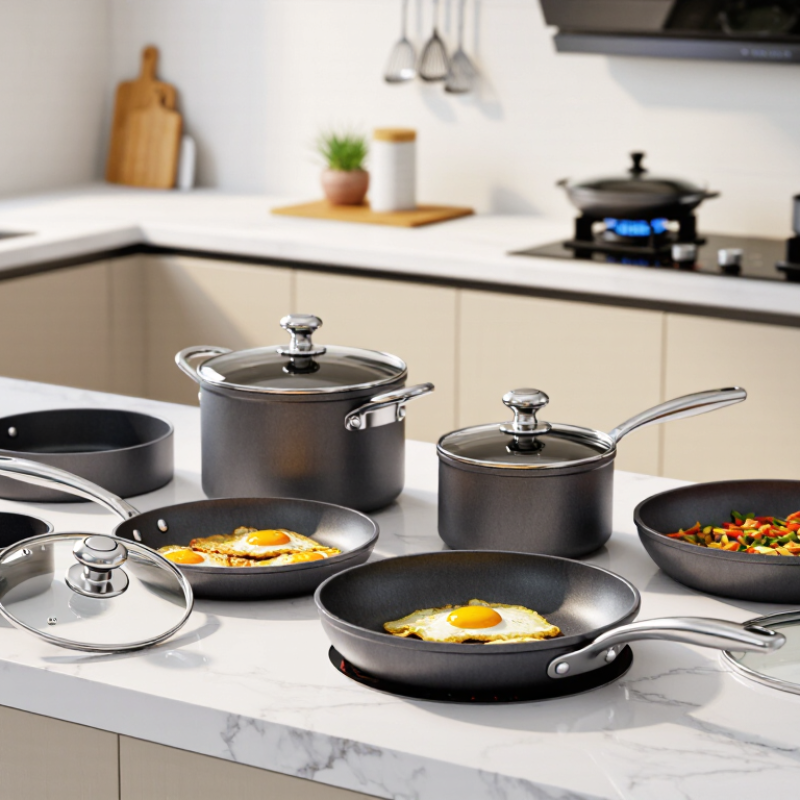
The 2026 nonstick cookware market is expanding, but published estimates do not fully agree. Mordor Intelligence forecasts a market value near USD 8.6 billion in 2025, reaching about USD 10.9 billion by 2030. Its estimated compound annual growth rate is approximately 4.8%. IMARC reports a faster trajectory, with global sales estimated at roughly USD 10.5 billion in 2024. It projects growth through 2033. These differences reflect varied product definitions and research methods.
Regional demand is uneven. Asia-Pacific remains a major production and consumption center, supported by urban households, compact kitchens, and rising disposable income. North America shows steady replacement demand, especially for induction-compatible pans and durable ceramic coatings. Europe is more specification-driven. Buyers increasingly examine material declarations, coating performance, energy use, and packaging waste. That changes factory requirements.
Quality is visible in small details. A thicker aluminum body can reduce hot spots. Controlled spraying improves coating consistency. Repeated abrasion, thermal cycling, and handle-load tests reveal weak production controls. Manufacturing audits should also review traceability and worker training. Reports often emphasize growth, not failure rates. That is a gap worth questioning. Market growth alone cannot prove product reliability. Forecasts may also shift when housing, freight, or raw-material costs change. Manufacturers serving 2026 demand should therefore compare regional sales data with factory-level testing, not rely on headline CAGR figures alone.
Choosing a 2026 nonstick cookware manufacturer requires more than reading a country-of-origin label. The useful question is how the factory controls coating chemistry, aluminum forming, and final inspection. In 2023, global output followed three main paths: PTFE systems, ceramic sol-gel coatings, and aluminum cookware bodies. Public estimates differ because some reports count finished pans, while others measure coating materials or metal volume.
PTFE remained important because its smooth surface supports easy release and consistent cooking performance. However, coating quality depends on surface preparation, primer bonding, curing temperature, and thickness control. A reliable manufacturer should provide traceable batch records and food-contact testing. Small defects matter. A pinhole near the rim can grow after repeated heating and washing. PTFE is not magic.
Ceramic coatings offered a different route in 2023, often using silica-based layers over formed aluminum. They can feel hard and clean in the beginning, but durability varies with formulation, heat exposure, and utensil habits. Aluminum continued to dominate cookware production because it transfers heat quickly and remains relatively light. Yet thin aluminum may warp, while thicker bodies increase weight and cost. “Ceramic” does not automatically mean tougher, and “made in” does not prove better process control. I would compare coating thickness, adhesion tests, thermal cycling results, and warranty data before judging a manufacturer. Some factory claims still need closer verification.
| Material or coating system | 2023 global output or reporting status | Documented technical characteristics | Cookware application | Key manufacturing considerations |
|---|---|---|---|---|
| Aluminum, primary metal | Approximately 70 million metric tonnes of global primary aluminum smelter production in 2023. This figure refers to primary aluminum, not finished cookware. | Aluminum has a density of approximately 2.70 g/cm³ and thermal conductivity of about 205 W/m·K for commercially pure aluminum at room temperature. | Common substrate for nonstick frying pans, saucepans, bakeware, and pressure-cookware components because it is lightweight and transfers heat efficiently. | Thickness, flatness, alloy selection, forming quality, base reinforcement, and compatibility with induction cooktops strongly affect finished-pan performance. |
| PTFE nonstick coating | A separate, authoritative global 2023 output total for PTFE cookware coatings is not publicly reported as a distinct commodity category. Published fluoropolymer data commonly combine several resin families and end uses. | PTFE melts at approximately 327°C. Its commonly cited continuous-use limit is around 260°C, depending on grade, design, and exposure conditions. It provides very low surface friction and strong chemical resistance. | Used as a low-stick cooking surface, usually applied over a prepared metal substrate in multiple coating layers. | Surface preparation, primer selection, coating thickness, curing temperature, adhesion, abrasion resistance, and process control determine service life. Empty-pan overheating should be avoided. |
| Sol-gel ceramic nonstick coating | A separate, authoritative global 2023 output total for ceramic cookware coatings is not publicly reported. “Ceramic” cookware coatings are generally treated as formulated coating systems rather than a standalone global commodity. | Typically formed from a sol-gel formulation containing inorganic or mineral-derived components. It is not the same as a solid ceramic vessel, and performance varies substantially by formulation and curing process. | Applied as a thin nonstick layer over aluminum or another metal substrate. It can provide a smooth, hard initial cooking surface without using PTFE as the primary nonstick film. | Uniform film thickness, substrate pretreatment, curing profile, thermal cycling, oil management, and resistance to abrasion are important quality variables. |
| Hard-anodized aluminum | No separate official 2023 global output series is generally published for hard-anodized cookware. It is a processed aluminum product category, not a separately reported primary-metal output. | Anodizing converts the aluminum surface into a thicker aluminum-oxide layer. The oxide is harder and more wear-resistant than untreated aluminum, but it is not inherently equivalent to a nonstick coating. | Often used as a durable pan body or surface foundation; a separate PTFE or other coating may be added when release performance is required. | Bath chemistry, electrical current density, oxide thickness, sealing, dimensional control, and post-treatment consistency affect corrosion and wear performance. |
| Aluminum cookware substrate | Finished cookware output is not represented by the 70-million-tonne primary-aluminum figure. The primary-metal statistic includes transportation, construction, packaging, electrical, machinery, and other uses. | Aluminum’s low density supports lighter products than many ferrous alternatives, while its high thermal conductivity can help distribute heat rapidly when the pan geometry is well designed. | Suitable for stamped, forged, cast, and machined cookware designs. It is frequently paired with a separate nonstick coating or a bonded induction plate. | Tooling accuracy, wall thickness, rim strength, base flatness, coating adhesion, handle attachment, and final inspection are central manufacturing controls. |
| Data interpretation for 2026 sourcing | Public statistics provide a robust global figure for primary aluminum, but they do not provide comparable 2023 global output totals for PTFE or ceramic cookware coatings. | Coating chemistry alone does not establish product quality. Performance depends on the complete system: substrate, pretreatment, layer structure, curing, thickness, testing, and use conditions. | For supplier comparison, evaluate heat distribution, release performance, abrasion testing, thermal-cycle testing, food-contact compliance, induction compatibility, and warranty data. | Request product-level test reports and manufacturing specifications rather than relying only on coating names or broad claims such as “ceramic,” “stone,” or “premium nonstick.” |
For 2026, the best nonstick cookware manufacturers should treat compliance as a design requirement, not a marketing phrase. FDA 21 CFR 175.300 covers resinous and polymeric coatings used with food. It sets conditions for safe use and extractives, but it is not a universal FDA approval. Reliable factories should document coating formulas, curing temperatures, food-contact tests, and batch traceability. Small details matter, such as an even surface inside the rim and no exposed metal near the handle.
EU Regulation 1935/2004 requires food-contact materials to avoid harmful transfer, taste changes, or composition changes. Manufacturers selling in Europe also need suitable declarations and supporting test records. PFAS controls require extra caution. ECHA’s 2023 restriction proposal addresses more than 10,000 PFAS substances. EFSA’s 2020 scientific opinion set a group tolerable weekly intake of 4.4 nanograms per kilogram of body weight for four major PFAS. Rules continue changing across markets. A certificate may look complete, yet miss a processing aid or supplier change. That gap deserves attention.
Tips: Ask for recent migration reports, not only factory certificates. Check testing against the actual pan, coating thickness, cooking temperature, and food simulants. Request written PFAS statements with defined detection limits. Also inspect production samples, because paperwork cannot reveal every curing defect. I would not rely on “PFOA-free” alone; it does not automatically prove the entire coating is PFAS-free.
A factory evaluation should begin with evidence, not attractive product photos. Ask for the current ISO 9001 certificate, its scope, issuing body, and expiration date. ISO 9001 confirms a quality management system, not perfect cookware. That distinction matters. Visit production areas when possible. Check whether incoming aluminum, handles, and coatings receive documented inspections.
Traceability should reach each finished pan. A reliable factory can connect a carton to a production date, line, coating batch, operator, and inspection record. Test this process with one sample. Can staff retrieve its data within minutes? If records require repeated searching, the system may be weaker than the presentation suggests. Batch coding should remain readable after normal packaging and handling.
Coating thickness needs measured data, not a general phrase like “thick coating.” Request the target range, test method, sampling frequency, and actual results. Inspectors may use calibrated gauges, cross-section analysis, or both. Results should identify coating layers and show variation across the cooking surface. Thickness alone cannot predict durability. Adhesion, abrasion, thermal cycling, and release performance also need controlled testing.
QC data should include failed samples, corrective actions, and retest results. A factory showing only perfect numbers deserves careful questions. Real production has occasional defects. The important issue is whether teams identify causes and prevent recurrence. I would also compare factory records with independent laboratory results. That extra step costs time, but it often exposes gaps hidden by polished documentation.
For a 2026 nonstick cookware ranking, country of origin is useful, but never decisive. Manufacturing standards vary between factories, even within one country. I assess production transparency, coating consistency, base construction, and documented quality controls. Products made in Germany, Italy, Japan, South Korea, China, and other regions can perform well when testing is rigorous. The factory matters more than the flag.
Warranty terms reveal a manufacturer’s confidence. Strong coverage should state the period, coating limitations, replacement process, and proof of purchase requirements. A five-year warranty sounds impressive, yet exclusions may reduce its value. Some policies cover structural defects but exclude normal surface wear. That difference deserves careful reading. Customer support response time also affects practical reliability.
Performance testing should use repeatable measurements. I compare preheating speed, heat distribution, food release, handle temperature, pan flatness, and coating wear after repeated washing. Eggs should slide without excessive oil. A center temperature gap above 25°C may signal uneven cooking. After 100 cleaning cycles, visible scratches or bubbling lower the score. These figures are helpful, though not perfect. Home stoves, utensils, and cooking habits can change results.
My ranking gives weight to performance, warranty clarity, and manufacturing evidence before origin. A durable pan with transparent testing may outrank a prestigious country label. I would still recheck supplier records each year, because factories and coating formulas can change. Some published tests also use limited samples. That is a weakness worth admitting.
One forecast expects about USD 10.9 billion by 2030. Estimates differ because research methods and product definitions vary.
Asia-Pacific benefits from urban households, compact kitchens, and rising incomes. North America has steady replacement demand. Europe values detailed product specifications.
Request the current ISO 9001 certificate, scope, issuer, and expiration date. Also inspect incoming materials and production records.
Select one finished pan and request its production details. Staff should locate the coating batch, line, date, and inspection record within minutes.
No. Adhesion, abrasion, thermal cycling, and food-release tests also matter. A thick coating can still fail.
Ask for actual results, failed samples, corrective actions, and retest records. Perfect numbers alone may hide weaknesses.
No. Factory controls matter more than the country label. Rigorous testing can produce reliable cookware in many regions.
It should state coverage length, coating limits, replacement steps, and purchase requirements. A long warranty may still exclude normal surface wear.
Compare heat distribution, preheating speed, food release, handle temperature, flatness, and coating wear. After 100 cleaning cycles, scratches matter.
Rankings can guide comparisons, but samples may be limited. Home stoves, utensils, and cooking habits can change results. Recheck supplier records annually.
This guide evaluates the 2026 nonstick cookware market through growth trends, regional demand, and manufacturing capacity. It explains how PTFE, ceramic, and aluminum technologies shaped global production in 2023, while highlighting differences in durability, heat performance, release properties, and environmental considerations. The analysis also reviews how changing consumer preferences and regional purchasing patterns may influence future demand.
A practical factory assessment focuses on ISO 9001 systems, material traceability, coating thickness, adhesion testing, surface consistency, and documented quality-control data. It also outlines the importance of compliance with FDA 21 CFR 175.300, EU 1935/2004, and applicable PFAS requirements. The final Made In Nonstick manufacturer ranking framework compares country of origin, warranty terms, production reliability, safety documentation, and performance metrics, helping buyers distinguish consistent, transparent manufacturers from suppliers with limited verification.

Top Ideas