Choosing the 2026 Best Authentic Kitchen Cookware Suppliers requires more than comparing polished product photos. Buyers now examine material origin, manufacturing transparency, food-contact safety, durability, and after-sales support. A genuinely authentic pan should feel substantial, heat evenly, and show honest construction details, such as clean rivets, stable handles, and consistent finishing.
Industry data shows why this market deserves careful evaluation. Grand View Research estimates the global cookware market reached approximately $19.7 billion in 2023, with continued growth forecast through 2030. Fortune Business Insights reports a similar 2023 value, but projects a different long-term market size. That gap matters. Report methods differ, so no single number should be treated as absolute truth. Still, both reports indicate strong demand for reliable cookware and premium materials.
Performance matters most.
Thomas Keller, an influential chef and culinary authority, said, “A recipe has no soul. You, as the cook, must bring soul to the recipe.” His point also applies to cookware. The supplier provides the tool, but quality appears through daily use: steady simmering, balanced weight, easy cleaning, and dependable results. Some “authentic” claims remain vague, however. Country-of-origin labels may not explain where metals, coatings, or components were produced. This guide examines suppliers through evidence, not slogans. It considers factory capability, certifications, product testing, warranty terms, and customer feedback. The strongest suppliers may not be the loudest. They are usually the ones willing to document what they make.
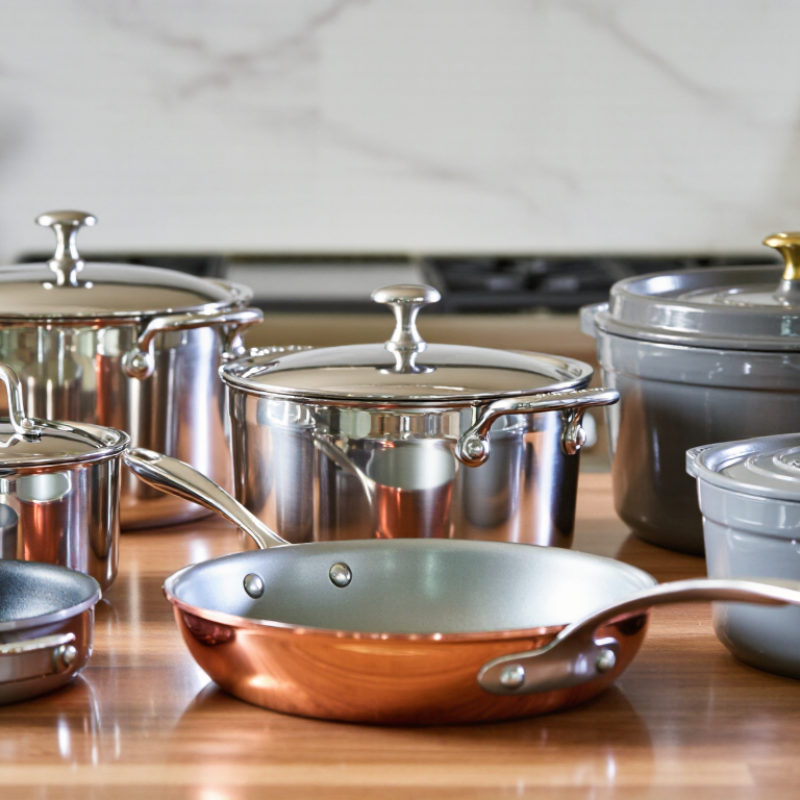
An authentic kitchen cookware supplier in 2026 offers more than attractive product photos. It provides clear evidence about materials, manufacturing, testing, and after-sales support. Buyers should request specifications for steel grades, aluminum thickness, coating composition, and handle construction. Vague descriptions deserve careful questions.
Traceability matters in daily sourcing. A reliable supplier can identify the production site, inspection process, and batch records. It should provide food-contact test reports from qualified laboratories and explain which standards apply to each market. Factory audits, sample approvals, and written warranties add practical confidence. Still, paperwork alone is not enough. A certificate may be current, but the delivered pan must match the tested sample.
Real experience often appears in small details. Packaging should protect rims and glass lids during transport. Cooking surfaces should remain even after repeated heating and washing. Ask for samples, then inspect the base, rivets, balance, and finish under normal kitchen conditions. Do not judge one item too quickly. Suppliers should also give precise care instructions, replacement options, and realistic lead times. Some honest suppliers admit a production weakness and show how they corrected it. That is more credible than perfect claims. Communication can still be imperfect, especially across time zones, so response records and agreed specifications should remain easy to verify.
| Evaluation Dimension | Authenticity Benchmark | Reliable Data or Specification | Recommended Verification Evidence |
|---|---|---|---|
| Material Transparency | Every product should clearly identify the cooking surface, core material, exterior layer and handle material. | Typical premium constructions include 304-series stainless steel cooking surfaces, 430-series stainless steel induction layers and cast or hard-anodized aluminum bodies. | Material specification sheet, independent alloy analysis, mill certificate and product cross-section photographs. |
| Food-Contact Compliance | Materials and coatings must comply with the regulations of the intended sales market. | Common reference frameworks include U.S. FDA food-contact requirements, EU Regulation (EC) No. 1935/2004 and applicable national requirements such as Germany’s LFGB. | Food-contact declaration, migration-test report, laboratory accreditation and test-method details. |
| Coating Authenticity | Non-stick claims should identify the coating type, application process and service limitations rather than using generic “non-toxic” language. | A credible specification states whether the surface is PTFE-based, ceramic sol-gel or uncoated, together with temperature, utensil and cleaning guidance. | Coating technical data sheet, batch traceability, abrasion testing and written care instructions. |
| Induction Compatibility | Induction suitability should be demonstrated through a magnetic base and performance testing, not only a marketing symbol. | Common induction constructions use a magnetic stainless-steel disc or a magnetic stainless-steel layer integrated into the base. | Magnet test, induction heating test, base-construction diagram and compatibility statement for the target cookware sizes. |
| Thermal Performance | The supplier should explain how the construction distributes heat and reduces hot spots. | Aluminum is widely used as a heat-spreading core, while stainless steel is commonly selected for corrosion resistance and food-contact durability. | Thermal-uniformity test, heating-map report, thickness specification and independent performance sample. |
| Durability Testing | Products should be tested under realistic cooking, washing and handling conditions before mass production. | Relevant checks may include dishwasher-cycle testing, handle-load testing, thermal cycling, corrosion testing and coating-abrasion testing. | Test protocol, sample quantity, pass/fail criteria, dated results and corrective-action records. |
| Dimensional Consistency | Authentic suppliers control wall thickness, base flatness, lid fit and handle alignment across production batches. | Commercial specifications should define product diameter, capacity, weight tolerance, wall/base thickness and flatness tolerance. | Approved technical drawing, inspection report, calibrated measuring equipment and first-article inspection record. |
| Traceability | Raw materials and finished goods should be traceable from production lot to shipment. | A robust system records material batch, production date, line or workstation, inspection status and shipment lot. | Lot-code example, production record, barcode system and sample recall procedure. |
| Quality Management | Documented quality procedures should operate consistently rather than relying only on final visual inspection. | ISO 9001 certification is a useful quality-system reference when the certificate scope covers the relevant manufacturing activities. | Current certificate, certification scope, audit status, inspection plan and nonconformance records. |
| Environmental Management | Responsible suppliers measure resource use and manage emissions, waste and restricted substances. | ISO 14001 is a recognized environmental-management reference; recycled metal content should be stated as a verifiable percentage when claimed. | Current environmental certificate, recycled-content evidence, waste records and restricted-substance declaration. |
| Responsible Manufacturing | Supplier authenticity includes transparent labor and workplace practices, not only product quality. | Relevant controls include workplace safety, working-hour records, legal wages, grievance procedures and subcontractor oversight. | Social-audit report, corrective-action plan, factory policy and subcontractor disclosure. |
| Packaging and Logistics | Packaging should protect cookware efficiently while reducing avoidable material and shipping damage. | Useful data includes carton dimensions, packed weight, drop-test results, packaging material composition and pallet configuration. | Packaging drawing, drop-test report, carton test certificate and shipment-damage statistics. |
| Customization Capability | Design changes should be supported by engineering controls, tooling ownership and documented sample approval. | Typical customization areas include capacity, handle design, lid style, surface finish, coating color, packaging and private-label documentation. | Engineering drawings, prototype approval form, tooling register and change-control procedure. |
| Order and Lead-Time Reliability | Delivery claims should be based on documented production capacity and agreed milestones. | A credible quotation states minimum order quantity, sampling time, production lead time, inspection point and shipping terms instead of providing an unexplained fixed promise. | Capacity plan, production schedule, purchase-order milestones and historical on-time-delivery data. |
| After-Sales Accountability | The supplier should define responsibility for defects, replacements, technical support and product complaints. | A professional warranty or quality agreement specifies defect classification, response time, replacement process and evidence requirements. | Warranty terms, complaint log, response-time records and signed quality agreement. |
| Data Authenticity | Claims should be supported by current, product-specific evidence rather than generic certificates or copied specifications. | Documents should match the exact model, material, coating, manufacturing site and applicable market requirements. | Certificate-scope check, issuing-laboratory confirmation, document date, model number and production-site match. |
Reference note: The benchmarks above describe commonly used 2026 supplier-screening criteria. Exact legal requirements, test methods and specifications should be confirmed for the destination market and the individual cookware product.
Compare stockpots, skillets, saucepans, frying pans, and ceramic bakeware. Match each category to the target cooking environment. One size rarely fits every kitchen.
Request clear stainless-steel grades, such as 304 or 316. Ask for composition reports and food-contact test results. Vague descriptions need caution.
Check seasoning consistency, surface smoothness, and corrosion resistance. Inspect the rim under bright kitchen lighting. Small rough areas can become return problems.
Request coating thickness, abrasion resistance, thermal stability, and restricted-substance documents. Check coating adhesion after repeated heating. A glossy surface proves very little.
Ask for heat numbers, batch records, factory addresses, and recent inspection reports. These details connect a product to its production history. Without them, investigation becomes difficult.
Check handle joints, lid fit, base flatness, unfinished rims, and packaging damage. Use normal lighting and photograph every defect. Measure, do not only guess.
Test compatible cookware on an induction hob when relevant. Record heating changes and inspect warping after repeated use. The sample may perform differently from documents.
Compare minimum order quantities, production times, packaging methods, and communication speed. Request written dimensions, weights, coating thicknesses, and tolerances. Delays still happen.
No. Certificates should support factory checks, sample inspections, and batch records. Even careful reviews can miss inconsistent production. Build in a pilot order.
Record the issue with photos, measurements, batch information, and delivery details. Use the evidence during fair negotiations. Some suppliers avoid accountability, unfortunately.
Choosing the best Authentic Kitchen Cookware supplier in 2026 requires more than comparing prices. A reliable supplier should demonstrate consistent product quality, transparent material standards, responsible manufacturing, and compliance with relevant food-contact safety requirements. Buyers should evaluate essential categories such as stainless steel, cast iron, aluminum, nonstick, and ceramic cookware, while checking durability, heat performance, coating safety, and construction details. Supplier claims should be verified through product samples, technical documents, factory information, quality-control procedures, and independent testing where appropriate.
A practical purchasing decision should also consider minimum order quantities, customization capabilities, packaging, lead times, shipping arrangements, warranty support, and communication efficiency. The ideal supplier can provide flexible solutions without compromising safety or reliability. By comparing suppliers through a structured framework that balances product performance, manufacturing transparency, total cost, delivery dependability, and long-term service, businesses can select a trustworthy cookware partner suited to their target market and operational needs.

 Top Ideas